Contents
How to read this book
The book is a working manual. Each chapter stands on its own. A lawyer who has never held a gun can read this book and understand all the details on which these cases turn.
Parts 1 and 2 build the mechanical and human-factors foundation. Parts 3 and 4 walk the internal architecture of the P320 and the P365 at the level of individual parts, springs, and tolerances. Part 5 is the docket, current through publication. Parts 6 and 7 are the winning and losing strategies on each side. Part 8 covers class actions, state attorney general suits, and the multidistrict-litigation posture. Part 9 is the expert workflow and the evidence-preservation protocol. Part 10 is model pleading and motion language ready to be adapted to a specific case. The appendix is a case list with pin cites.
- 01The pistol, the platform, and the partsRead ›
- 02The four safety rules and human factorsRead ›
- 03The alleged defect, in mechanical detailRead ›
- 04The P365, in parallelRead ›
- 05The docket and the recordRead ›
- 06Plaintiff strategyRead ›
- 07Defense strategyRead ›
- 08Class actions, MDLs, and state AG suitsRead ›
- 09Expert work, protocols, and evidence preservationRead ›
- 10Sample pleading and filing languageRead ›
- ACase appendix and sourcesRead ›
This book is a reference for counsel. It is not legal advice, and it does not create an attorney-client or expert-client relationship. Retain qualified counsel and a qualified expert for any actual matter.
Part 1 · The Pistol
The pistol, the platform, and the parts
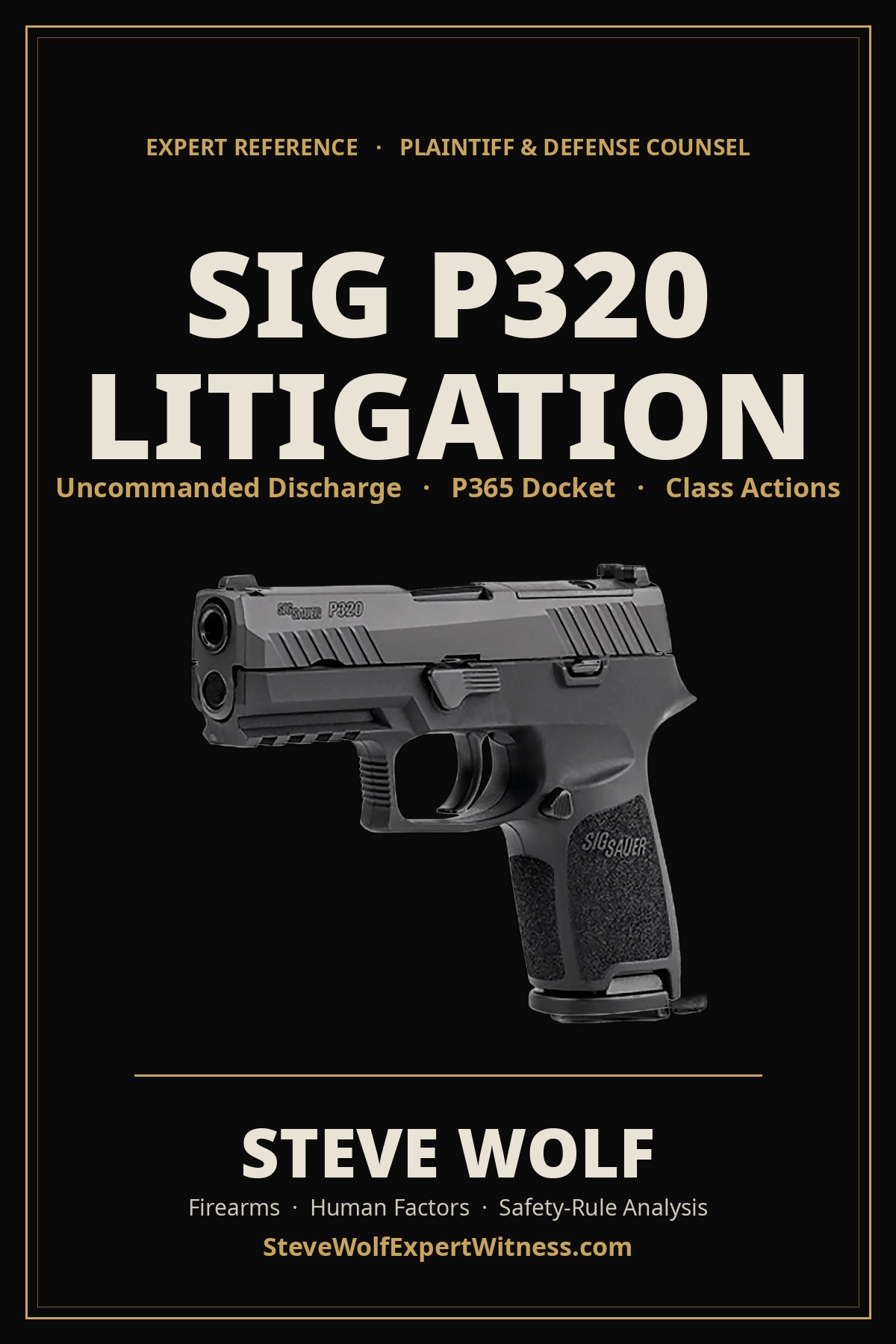
The SIG Sauer P320 is a striker-fired, polymer-framed, modular pistol. Modular means the serialized part is not the frame the shooter holds. The serialized part is a small stainless-steel chassis inside the pistol called the Fire Control Unit, or FCU.
SIG Sauer released the P320 in 2014. The U.S. Army selected a variant, the M17, as its service pistol in 2017. The compact variant is the M18. The Air Force and the Navy adopted the same platform. Federal, state, and municipal police agencies followed. By 2026 SIG had sold more than three million pistols on this platform in the United States. The P365 is a smaller pistol released in 2018. It shares the striker-fired architecture but not the trigger group.

The Fire Control Unit is the gun
The Federal Firearms License and the serial number stay with the FCU. The shooter can drop the FCU into a Compact grip module, a Full-Size grip module, or an X-Carry grip module. The shooter can change slides. The pistol looks like a different gun after the swap. The gun in the eyes of ATF is the small stainless part in the middle.

Every mechanical claim in a P320 case turns on parts inside the FCU. That is why the FCU is photographed, measured, and preserved in every serious investigation. A P320 case without FCU inspection is not a P320 case. It is speculation.
Naming the parts
Counsel needs a working vocabulary. I use these definitions consistently in reports and depositions.
- StrikerThe spring-loaded rod that hits the primer of the cartridge. In the P320 the striker is under tension whenever a round is chambered. The pistol is fully cocked at that point, not partially cocked as some competing designs are.
- Striker springThe coil spring that drives the striker forward when the sear releases the striker. The stored energy in this spring is what fires the round.
- SearThe small metal lever that holds the striker back against spring pressure. The sear is the primary mechanical block against discharge.
- Striker safety leverAn L-shaped tab on a torsion spring inside the slide. It moves into the path of the striker when the trigger is at rest, and moves out of that path when the trigger is pressed. This is the secondary mechanical block. In P320 documentation SIG has also called this the striker safety.
- Trigger barThe long lever that runs from the trigger, through the FCU, and up to the sear. Pressing the trigger drives the bar rearward, which pivots the sear off the striker.
- DisconnectorA mechanical part added by SIG in the 2017 Voluntary Upgrade. It prevents the striker from releasing if the slide is out of battery.
- SlideThe steel top half of the pistol that reciprocates during firing. The striker, striker spring, and striker safety lever live in the slide.
- Grip moduleThe polymer frame the shooter holds. This part is not serialized. The shooter can buy it separately, in different sizes and colors.
- MagazineThe removable box that feeds cartridges into the chamber. Nothing in the magazine affects the discharge claim in a P320 case.
The M17 and the M18
The M17 is a P320 with a full-size slide and a coyote-tan frame. The M18 is a P320 with a compact slide and the same coyote-tan frame. Both carry a manual thumb safety, unlike the commercial P320. The U.S. military required a manual safety in the contract. This fact matters in the Air Force chapter of the docket, because the M17 and M18 have an external safety and the commercial P320 does not.

The P365, briefly
The P365 is a subcompact, single-stack, striker-fired pistol released in 2018. SIG designed the P365 as a ground-up striker gun, not a conversion of a hammer-fired predecessor. The internal architecture is different from the P320. I cover the P365 in Part 4.

Part 2 · Human Factors
The four safety rules and human factors
Every uncommanded-discharge case begins with the four rules of firearm safety. Counsel who cannot recite them cannot cross an armorer, an officer, or a defense expert.
I trained under Colonel Jeff Cooper's four rules of firearm safety. They are the standard of care in every firearms training program I know of. They are also the standard I apply in every case in which a firearm has caused injury. I have rewritten them for greater specificity, and this is the version I use.
Rule 1. All guns are always loaded.
Rule 2. Never allow a gun to point at anything you don't want to see destroyed.
Rule 3. Keep your finger off the trigger until the sights are on your target.
Rule 4. Always be sure of your target and what's beyond it.
The four rules, as I teach and apply them
Every rule is redundant to the next. Break one, no one gets hurt. Break two, someone might. Break three or four, someone is going to. In an uncommanded-discharge claim the plaintiff's case is that the operator obeyed Rule 3 (finger outside the trigger guard) and the pistol fired anyway, which means the discharge cannot be attributed to trigger manipulation. The defense case is that Rule 3 was in fact violated, usually by clothing, a foreign object, or finger contact inside the trigger guard, and that the pistol operated as designed.
How the four rules structure the investigation
Plaintiff must show
The shooter's finger was off the trigger. Nothing entered the trigger guard. The pistol was holstered or handled per training. The pistol fired anyway.
Defense must show
Something contacted the trigger. Cloth, drawstring, holster liner, seatbelt buckle, key, finger, or foreign object. The pistol operated exactly as designed.
Human factors, not victim blaming
Human factors is the field that studies how people interact with equipment under stress. It is not a synonym for user error. A well-designed pistol tolerates predictable human variation. A poorly designed pistol punishes it. The question in every uncommanded-discharge case is which side of that line the pistol sits on. Counsel who frames human factors as user error loses jurors. Counsel who frames it as system design keeps them.
The holster and the trigger guard
Rule 3 says the finger stays outside the trigger guard until the sights are on target. A holster's job is to keep everything else outside the trigger guard too. Most claimed uncommanded discharges in the P320 record happen while the pistol is holstered. The holster is therefore evidence. Counsel who does not preserve, photograph, and inspect the holster has lost a central piece of proof.
Preserve the holster in the same condition it was in at the moment of the discharge. Do not clean it. Do not remove debris. Photograph the interior under magnification. Look for shell casings, cloth fibers, drawstrings, keys, and coins. The presence of a foreign object supports the defense. Its absence supports the plaintiff.
Part 3 · The Alleged Defect
The alleged defect, in mechanical detail
The plaintiff theory is that the P320 can fire without a trigger press. The defense theory is that it cannot. This chapter walks the mechanical architecture that both sides argue about.
The two-lock architecture
The P320 has two mechanical blocks between the striker and the primer. The sear is the first. The striker safety lever is the second. Both must move for the pistol to fire.
When the pistol is at rest with a round chambered, the striker is under full spring tension, held back by the sear. The striker safety lever sits in the path of the striker, blocking forward movement even if the sear were to fail. The pistol is not partially cocked in the way a Glock is. In the Glock design the striker is only partially tensioned at rest; pressing the trigger completes the cocking cycle. In the P320 design the striker is fully tensioned at rest.

What the trigger does
When anything presses the trigger, the trigger bar moves rearward. The pistol does not know or care what pressed it: a finger, a drawstring, a shell casing in the holster, or an internal component under inertia will all initiate the same sequence. Two things happen. First, a cam on the trigger bar lifts the striker safety lever out of the striker's path. Second, the rear of the trigger bar pushes the sear downward, off the striker. The striker is now free. The striker spring drives the striker forward. The striker tip hits the primer. The round fires.
Nothing else in the FCU can release the striker without the trigger bar moving. That is the design. The question in every uncommanded-discharge case is whether something else can, in fact, release the striker.
The plaintiff theories
Plaintiff experts have advanced four mechanical theories in P320 litigation. Each has fared differently in court.
- Sear cliff theoryThe sear-striker engagement surface is measured in fractions of a millimeter. Plaintiffs argue that manufacturing variance and metal fatigue reduce the effective engagement over time, and that a jarred or dropped pistol can bump the sear off the striker without a trigger press.
- Striker safety lever bypassThe L-shaped tab that blocks the striker sits on a torsion spring. Plaintiffs argue the tab can be pushed out of position by slide-to-frame play, by the striker itself under retention-spring decay, or by aggressive holster reinsertion. If the lever is out of the way and the sear fails, the pistol fires.
- Trigger bar geometryPlaintiffs point to the trigger bar's angle of contact with the sear. Small changes in slide-to-frame play, they argue, can allow the trigger bar to move enough to release the sear even without shooter contact with the trigger.
- Retention spring decayThe spring that holds the striker safety lever in position may lose load over thousands of cycles. Plaintiffs argue that a decayed spring cannot resist small displacements, and that this is why some P320s discharge after many rounds and none in the first 500.
The defense response
The defense response to each theory is consistent. The pistol has two independent mechanical blocks. Both must move for the pistol to fire. No plaintiff expert has documented, on video, an uncommanded discharge on an intact, unmodified P320 with the 2017 upgrade parts installed. The absence of that video is the defense's strongest fact.
The sear movement test: with the slide off the frame, the FCU exposed, and the striker held in tension by a jig, press downward on the exposed sear through the slide gap while observing the striker. On an intact 2017-upgrade pistol the sear resists movement until direct pressure is applied. On a pistol with worn parts, out-of-spec parts, or missing 2017 upgrade parts, the sear can move under pressures that plaintiffs argue are within the range of a jarred holster reinsertion. Preserve the pistol. Do not clean it. Photograph every step.
The 2017 Voluntary Upgrade Program
In August 2017 SIG announced a Voluntary Upgrade Program for the P320. The upgrade is free. It has no expiration. SIG describes the changes as a lighter trigger, a lighter sear, a lighter striker, and a mechanical disconnector added to prevent the striker from releasing when the slide is out of battery. The program followed reports that early P320s could discharge if dropped at a specific angle onto the rear of the slide. Every P320 case involves two questions about the 2017 upgrade. First, did the subject pistol receive the upgrade? Second, did the alleged defect survive the upgrade? Plaintiff cases against upgraded pistols require a mechanical theory that the upgrade does not cure. Defense cases against un-upgraded pistols point to the plaintiff's failure to accept a free fix.
Part 4 · The P365
The P365, in parallel
The P365 is not a small P320. It is a separate design. Litigation involving the P365 is now open, and the mechanical theories differ from the P320 record.
SIG released the P365 in January 2018 as a subcompact concealed-carry pistol. It fires the same 9mm cartridge as the P320. It shares no fire control parts with the P320. The FCU is smaller. The sear geometry is different. The striker safety is a plunger, not a lever.
Plunger, not lever
In the P365 the striker safety is a spring-loaded cylindrical plunger that sits in the striker's path. Pressing the trigger drives the plunger down, out of the way, as the trigger bar releases the sear. This is the same architecture used in the Glock and the Smith & Wesson M&P. It is not the L-shaped lever architecture of the P320.
The plunger design is regarded as more tolerant of debris and slide play than the lever design. That does not mean the P365 is immune to defect claims. The claims that have been filed target the sear geometry and the striker itself, not the plunger.
The 2018 striker breakages
In early 2018 SIG identified a heat-treatment issue in the striker tip on some P365s. The tips could break off after firing, leaving the pistol unable to fire. SIG replaced the affected strikers. The problem was a manufacturing defect, not a design defect, and it did not cause uncommanded discharges. It is mentioned in some P365 pleadings as evidence of quality-control failures at SIG. Counsel should be careful to keep the striker-tip issue separate from the current design-defect claims. Confusing the two invites summary judgment.
The 2026 P365 docket
Two P365 cases were pending as of September 10, 2026. Both allege uncommanded discharge from a holstered pistol.
- Harvard v. SIG Sauer, N.D. Ga. 1:25-CV-6891-TWT. Judge Thrash denied the motion to dismiss on August 7, 2026. The court rejected SIG's Second Amendment defense as a bar to a design-defect claim. The claim proceeds on the P365X variant.
- De Souza / Araujo v. SIG Sauer, M.D. Fla., filed July 2026. Alleges holstered discharge of a P365. Discovery is open. The plaintiff has not yet designated experts.
- Ashe v. SIG Sauer, N.Y. state court. Troy police detective, holstered P365, injury to the shooter's leg. Pleading stage.
The mechanical theories in these cases are still developing. Counsel on either side should read the amended complaint in Harvard for the current plaintiff theory of the case, and the SIG answer for the current defense theory. Neither has yet been tested at trial.
Part 5 · The Docket
The docket and the record
This chapter summarizes the state of the docket as of September 10, 2026. Cases are grouped by posture and by significance for a lawyer briefing a P320 or P365 matter.
Verdicts and appeals worth reading
| Case | Court | Posture | Why it matters |
|---|---|---|---|
| Lang v. SIG Sauer | N.D. Ga. 1:21-cv-04196-ELR | $2.35M plaintiff verdict (Jun. 20, 2024); new trial denied Feb. 6, 2025; on appeal, 11th Cir. 25-10810 | First plaintiff verdict on P320 uncommanded discharge. Jury found the P320 defective for lacking a tabbed trigger and SIG negligent for failing to warn. Read Judge Ross's Feb. 6, 2025 order denying new trial for the Daubert record on the plaintiff experts. |
| Abrahams v. SIG Sauer | Phila. C.C.P. (Pa.) | $11M plaintiff verdict (Nov. 20, 2024). $10M punitive, $1M compensatory | George Abrahams, a U.S. Army veteran, was shot when his holstered P320 discharged as he walked down a staircase, no hands on the gun. Jury found SIG negligent and reckless. First Pennsylvania P320 case to reach verdict. |
| Slatowski v. SIG Sauer | 3d Cir. 24-1639, 148 F.4th 132 (2025); on remand E.D. Pa. 21-729-RBS | Summary judgment for SIG reversed (Aug. 1, 2025); remanded for trial before Judge Surrick | ICE deportation officer, P320 discharged during a training exercise. Third Circuit held the district court abused its discretion by excluding the plaintiff's experts. Cite for expert-admissibility briefing. |
| Herman v. SIG Sauer | 10th Cir. 23-6136 (W.D. Okla. 5:21-cv-01038-R) | Defense summary judgment affirmed (Jun. 13, 2025) | Oklahoma case. The district court excluded plaintiff experts Vigilante and Tertin, then held that the remaining circumstantial evidence could not prove causation. Read as the standard defense playbook when Daubert challenges succeed. |
| Frankenberry v. SIG Sauer | D.S.C. | Summary judgment for SIG (Feb. 4, 2022) after Daubert exclusion of plaintiff's expert | An earlier Frankenberry, unrelated to Abrahams in Philadelphia. Read for the Daubert methodology the court found deficient. |
| Cole v. SIG Sauer | D. Me. 1:23-cv-00327 (Magistrate Judge Nivison presiding at trial) | Defense verdict (Aug. 7, 2026); JMOL for SIG on fraudulent concealment before submission | Somerset County (Maine) detective, holstered P320 discharged while executing a search warrant. Jury answered all three questions for SIG on product defect, negligence, and failure to warn. Read the jury instructions and the expert list for the defense playbook. |
| Jordan v. SIG Sauer | DeKalb Co. (Ga.) | Dismissed with prejudice (Aug. 2026) | Officer admitted trigger pull; plaintiff filed no expert reports. Read as a cautionary tale on Rule 26. |
| Colwell v. SIG Sauer | 2d Cir. | Reinstated (May 2026) | The Second Circuit ruled a jury may apply common sense to a mechanical defect claim. Cite the opinion in opposition to 12(b)(6) motions. |
| Glasscock v. SIG Sauer | 8th Cir. 25-2707 (W.D. Mo. 6:22-cv-03095-MDH) | Class certified Jul. 28, 2025; cert vacated Jul. 16, 2026; case dismissed Aug. 21, 2026 | Article III standing failure under the manifest-defect rule. The named plaintiff's P320 had never discharged, and his benefit-of-the-bargain theory was, in the Eighth Circuit's words, "wholly speculative." Read the opinion as the current outer limit on class certification for uninjured owners. |
| Armendariz v. SIG Sauer | D.N.H. 1:22-cv-00536-JL (Judge Laplante) | Motion to sever 20+ plaintiffs denied (Jun. 27, 2023), 2023 WL 4204666 | Anchor mass-joinder in SIG's home district. 56 additional plaintiffs have since been consolidated. A related consolidated action, Anderson v. SIG Sauer, D.N.H. 1:25-cv-00113-JL, denied a similar motion to sever on July 29, 2025. |
| Hartley v. SIG Sauer | W.D. Mo. 4:18-cv-00267-HFS (Judge Bough) | Nationwide class settlement final approval Jun. 25, 2020 | Settles case-rupture claims on pre-Aug. 8, 2017 P320s: ruptured cartridge cases that damaged the extractor, grip module, or frame. The settlement calls this a "Cartridge Failure Event." Provides a transferable lifetime warranty against future Cartridge Failure Events, extends the Voluntary Upgrade Program, and refunds prior repair charges. Expressly does not release personal-injury or uncommanded-discharge claims. This settlement is not about drop-fire and does not apply to holstered-discharge cases. Read the notice for the class definition SIG has already agreed to. |
| Harvard v. SIG Sauer | N.D. Ga. 1:25-CV-6891-TWT | Motion to dismiss denied (Aug. 2026) | P365X design-defect claim survives. Court rejected Second Amendment as a defense. |
| New Jersey v. SIG Sauer | Essex Co. Ch. Div. ESX-C-000217-25 | Pending (filed Oct. 2025) | State AG seeks a mandatory recall. First AG-led P320 suit. |
| Schreiber v. SIG Sauer | W.D. Wash. 2:25-cv-02303 | Pending (filed Nov. 2025) | Washington Consumer Protection Act class. Read as the current template for state-consumer-statute pleading. |
| Northrup v. SIG Sauer | Fla. 2d DCA 2D2024-0869 | PCA affirmance for defense (Feb. 2025) | Plaintiff experts did not test the subject pistol. Read as the standard defense theory of the case. |
MDL status
No P320 or P365 multidistrict litigation exists as of September 10, 2026. The Judicial Panel on Multidistrict Litigation has not consolidated the pending federal actions. Counsel should assume that jurisdictions will continue to develop separately, and should not rely on MDL discovery from another case.
The M17 and M18 and the Air Force facts
In July 2025 the U.S. Air Force grounded the M18 after the death of Airman Brayden Lovan at F.E. Warren Air Force Base. Initial reporting framed the death as an uncommanded discharge. The Associated Press subsequently reported, and Air Force filings confirmed, that a second airman named White-Allen fired the pistol and initially concealed the fact. Airmen involved in the incident pleaded guilty to false statements. The Air Force ungrounded the M18 in August 2025 after inspecting 7,970 pistols and identifying 191 with discrepancies in the safety lever, striker, or sear.
Any lawyer citing the Lovan case as evidence of an uncommanded discharge is citing incorrect facts. The correct citation is that a second airman fired the pistol and lied about it. The Air Force inspection of the M18 fleet, however, is a legitimate fact for both sides. Plaintiff counsel can point to 191 discrepancies in a fleet of fewer than eight thousand pistols. Defense counsel can point out that a discrepancy is not a defect, and that no M18 in the ungrounded fleet has been shown to fire without a trigger press.
Part 6 · Plaintiff Strategy
Plaintiff strategy
This chapter is the plaintiff playbook, drawn from verdicts, denied motions to dismiss, and the strategies that have failed.
What has won
- A uniformed officer or veteran with a duty holsterThe two large P320 plaintiff verdicts, Lang (N.D. Ga.) and Abrahams (Phila. C.C.P.), each involved a documented shooter, an agency-issued or personally-carried holster, and preserved physical evidence. The training and carry pattern were established. Juries credit the plaintiff's testimony about finger placement when the physical record supports it.
- A qualified plaintiff expert who tested the subject pistolThe Northrup affirmance turned on the plaintiff experts' failure to test the subject pistol. Do not repeat that error. The retained expert must personally inspect, photograph, and test the subject FCU, the slide, and the holster.
- Preservation letters within daysSend a preservation letter to the agency, the department armorer, and the manufacturer within days of the incident. Include the pistol, the FCU, the slide, the holster, the belt, the clothing, the magazines, and any ammunition remaining in the magazine.
- A specific mechanical theory pleaded with particularityVague claims that "the pistol was defective" invite Rule 12 motions. Plead the sear, the striker safety lever, and the specific tolerance failure. Cite the 2017 Voluntary Upgrade as evidence SIG knew of the issue and treated it as design-related, not user-related.
- A body-worn camera and a scene diagramBoth winning verdicts had body-worn camera footage of the moment of discharge. Absent BWC, a scene diagram with witness placement is essential. The jury needs to see, not just hear, that the officer's finger was off the trigger.
What has lost
- No expert reportJordan v. SIG dismissed with prejudice. The plaintiff filed no expert reports. Rule 26 deadlines are not extendable in most jurisdictions once the court sets them. Miss the deadline, lose the case.
- Admission of a trigger pullJordan again. The officer admitted the trigger was pulled. Every P320 plaintiff case that admits any trigger contact will lose, because the pistol did exactly what it was designed to do.
- Experts who did not test the subject pistolNorthrup PCA affirmance. Do not put an expert on the stand who tested a different P320 or who relied only on document review.
- Overbroad class definitionsGlasscock class certification vacated for lack of Article III standing when the class swept in owners with no injury. Do not plead a class of all P320 owners. Plead a class of P320 owners who purchased before the 2017 upgrade and who did not receive it.
- Ignoring the 2017 upgrade in the pleadingsEvery complaint must address whether the subject pistol received the 2017 upgrade. Ignoring it invites early summary judgment on assumption of risk and failure to mitigate.
Human factors, presented to the jury
The winning plaintiff frame is that the officer obeyed the four rules and the pistol fired anyway. The four rules govern the operator, not the pistol. When the officer's finger is outside the trigger guard, the muzzle is under control, and the pistol still discharges, the discharge cannot be blamed on trigger manipulation. Jurors accept that firearms are dangerous. They do not accept that a modern service pistol should fire from a properly worn holster when the officer's hand is nowhere near the gun. Frame the case that way. Do not lecture on the four rules; quote them, and show that the officer followed them.
Part 7 · Defense Strategy
Defense strategy
The defense playbook is well developed. SIG has won more than 20 P320 dismissals in the last three years. This chapter states the theory of the case that has produced those outcomes.
What has won
- Ownership of the trigger pressThe defense theme is that every discharge, from every P320, has a physical cause: a trigger press or something in the trigger guard. Own that narrative. Ask every plaintiff witness whether they can rule out a foreign object.
- The 2017 upgrade as a fact and as a shieldEvery P320 case turns on whether the subject pistol was upgraded. The upgrade is free, well publicized, and lifetime. A plaintiff who declined the upgrade voluntarily chose to keep the older configuration. Move for summary judgment on assumption of risk and failure to mitigate.
- Cross-examine the plaintiff's expert on the subject pistolThe Northrup playbook. If the plaintiff expert did not personally test the subject FCU, the subject slide, and the subject holster, the report is inadmissible under Daubert.
- Preservation demands that mirror plaintiff'sSend the plaintiff a preservation letter for the same items. If they lost the holster or the ammunition, move to exclude any argument about foreign objects.
- Preemption in military and police contextsWhere the pistol is a service weapon, plead the government contractor defense (Boyle v. United Technologies) and any state law tort reform that limits recovery against contractors performing to federal specification.
- State shield laws where applicableIn New Hampshire, HB 172 bars design-defect claims premised on the absence of an external safety. Cite it early.
What has failed
- Second Amendment as a merits defenseHarvard v. SIG. The court rejected the argument that a design-defect claim implicates the Second Amendment. Do not lead with a constitutional defense to a product-liability claim.
- Blame the shooter without a proffered foreign objectLang, Abrahams. Juries reject "the shooter must have done something" without a specific mechanism. Identify the foreign object or the finger contact, or do not argue trigger contact at all.
- Attacking the plaintiff's characterBoth losing defense verdicts featured aggressive impeachment of the plaintiff officer. Jurors read this as bullying. In a case where the plaintiff is a uniformed officer on a body-worn camera, plaintiff-shaming is a jury-alienation strategy.
Discovery moves that pay for themselves
- Rule 34 request for the holster, in the condition it was in at the time of discharge, with instructions not to clean or alter.
- Rule 34 request for the belt, the outer garment, the shirt, the pants, and any keys or coins carried at the scene.
- Rule 30(b)(6) deposition of the plaintiff's expert with a demand that the expert bring the FCU and the holster for on-record inspection.
- Rule 26(a)(2) motion to strike any expert who has not tested the subject pistol.
Part 8 · Class, MDL, and State AG
Class actions, MDLs, and state AG suits
A single officer's uncommanded-discharge claim can be won or lost on the officer's own facts. A class claim is a different animal. The pleading, the class definition, and the proof of injury are different.
How to plead a P320 class
The Eighth Circuit's Glasscock ruling is the current outer limit. A class that sweeps in all P320 owners fails Article III standing because the majority have suffered no injury. A class that is defined more narrowly can survive.
- Pre-upgrade owners who did not receive the upgradeThese plaintiffs still carry a pistol with the older sear, older striker, and no disconnector. Injury: economic (diminished value of a non-upgraded pistol) and safety (retained risk).
- State consumer-statute classesSchreiber (W.D. Wash.) pleads Washington's Consumer Protection Act. State consumer statutes may relax reliance and causation requirements that trip up common-law fraud classes.
- Public entities as sub-classAgencies that issued pre-upgrade P320s to officers face a distinct economic injury: the cost of replacing or upgrading the fleet. Sub-class them separately from individual retail purchasers.
What to avoid in class pleading
- Do not seek certification of a nationwide class on state-law claims. Choice-of-law defeats predominance.
- Do not sweep in owners who received the free upgrade. They have no retained injury.
- Do not plead punitive damages as a certifiable common issue. Punitive damages require individualized proof of state of mind.
Multidistrict litigation
As of September 10, 2026 there is no P320 MDL. Counsel considering a Section 1407 petition should consider two facts. First, defense verdicts (Cole, Herman) and plaintiff verdicts (Lang, Abrahams) coexist in the current docket. That mix argues against consolidation because different juries are reaching different results on similar facts. Second, SIG has resisted consolidation. Any petition should be prepared for a contested hearing before the JPML.
State attorney general suits
New Jersey filed the first attorney general suit against SIG in Essex County Chancery Division on October 16, 2025 (Docket ESX-C-000217-25). The suit seeks a mandatory recall. Washington's attorney general has since filed under Washington's Consumer Protection Act. State AG suits are structurally different from private plaintiff cases in two respects. First, the state need not prove individual injury; it pleads a public harm. Second, the state can seek injunctive relief a private plaintiff cannot, including a compelled recall. Counsel for either side should read the New Jersey complaint for the current template.
The Second Amendment defense
SIG has raised the Second Amendment as a defense in several matters, arguing that requiring an external safety would burden the right to keep and bear arms. The federal district court in Harvard v. SIG Sauer rejected the argument in August 2026. Design-defect law does not require an external safety on any pistol. It requires that the pistol be safe when used as intended. The Second Amendment does not shield a defective product from a product-liability claim.
Part 9 · Expert Work
Expert work, protocols, and evidence preservation
A P320 case rises or falls on the expert work. This chapter states the protocols I use, and the protocols I look for when the other side has hired an expert.
Retain a qualified expert early
The retained expert should hold documented firearms training and, ideally, credentials in fire and explosion investigation (NAFI CFEI) or a comparable field. The expert should have personally handled, disassembled, and tested P320s and P365s. Counsel who retains an expert whose only P320 experience is document review has lost the Daubert motion before it is filed.
The evidence-preservation protocol
- Isolate the pistolThe pistol goes into a sealed evidence bag with the FCU intact. Do not disassemble. Do not clean. Do not dry fire.
- Isolate the holsterThe holster goes into a separate sealed bag. Do not shake out debris. Do not clean.
- Isolate the ammunitionEvery round remaining in the magazine, and every round in the shooter's carry gear, goes into a separate bag. Note the manufacturer, the lot number, and the round count.
- Photograph in situPhotograph the pistol, the holster, the belt, and the scene before anything moves. Include a scale in each photograph.
- Chain of custodyEvery transfer of the pistol between agency, laboratory, plaintiff expert, and defense expert is documented in writing.
The inspection protocol
- External inspection firstPhotograph every external surface of the pistol. Note any tool marks, deformations, or missing parts.
- Function check dryVerify the pistol is unloaded three times. Confirm the striker resets, the trigger returns, and the slide cycles.
- Trigger-weight measurementUse a certified trigger-weight gauge. Record ten pulls. Report the mean and standard deviation.
- Slide-to-frame play measurementWith the slide fully forward, measure vertical, lateral, and rotational play at multiple points along the slide. The 2017 upgrade tightens tolerances; a well-played slide on a post-upgrade pistol is a finding.
- Sear-striker engagement measurementWith the slide removed and the FCU secured, measure the sear-striker overlap under magnification. Photograph. Compare to SIG's published specifications where available.
- Striker-safety-lever movementVerify the lever moves freely under the retention spring. Measure the spring load if a jig is available.
- Sear-movement testThe protocol described in Part 3. Document the force at which the sear releases under vertical pressure. Compare to a control pistol of the same generation.
- Reassembly and function checkReassemble under video. Confirm the pistol returns to normal function. Note any parts that were replaced during inspection.
A qualified retained expert does more than test the pistol. The expert prepares counsel to cross-examine the other side's expert, participates in Daubert briefing, and testifies at trial. Counsel who use their expert only for a written report leave value on the table. The book cannot replace a retained expert. It can prepare counsel to work with one.
Part 10 · Sample Pleading Language
Sample pleading and filing language
The blocks below are model language, drawn from surviving complaints, answers, and motions in the current P320 docket. Adapt to the facts of the case and to the local rules.
Complaint: strict liability, design defect
Sample · Count I, Strict Liability (Design Defect)
Plaintiff realleges and incorporates the preceding paragraphs. The SIG Sauer P320 pistol, Serial Number [X], designed and manufactured by Defendant, was defective in design when it left Defendant's control. The design defect renders the pistol unreasonably dangerous in that the pistol is capable of discharging without a trigger press when carried in a properly worn holster, as a result of one or more of the following: (a) inadequate sear-striker engagement geometry; (b) inadequate retention of the striker safety lever; (c) susceptibility of the trigger bar to release the sear under conditions of ordinary use; and (d) the absence, prior to the 2017 Voluntary Upgrade Program, of a mechanical disconnector that would prevent striker release when the slide is out of battery. Defendant knew or should have known of these design defects. The subject pistol did not receive the 2017 Voluntary Upgrade. On [date], while Plaintiff carried the subject pistol in a properly worn duty holster, and with Plaintiff's finger not on the trigger, the subject pistol discharged without a trigger press, causing the injuries described herein. A safer alternative design existed at the time of manufacture and has since been implemented by Defendant in the 2017 Voluntary Upgrade Program.
Complaint: breach of implied warranty of merchantability
Sample · Count II, Breach of Implied Warranty of Merchantability
Defendant is a merchant of firearms. The subject P320 was not merchantable at the time of sale. A merchantable service pistol does not discharge from a properly worn holster in the absence of a trigger press. The subject pistol so discharged on [date], to Plaintiff's injury. Timely notice of the breach was given by Plaintiff's counsel by preservation letter dated [date].
Complaint: state consumer-protection act (class)
Sample · Count III, [State] Consumer Protection Act, Class Claim
Plaintiff brings this claim under [State CPA cite] on behalf of a class defined as: All persons who purchased a SIG Sauer P320 pistol manufactured before August 8, 2017, and who did not participate in the Voluntary Upgrade Program announced by SIG Sauer on that date. Defendant's marketing of the P320 as a safe service pistol, and Defendant's failure to disclose the design conditions that led to the 2017 Voluntary Upgrade, constitute unfair and deceptive acts and practices within the meaning of the statute. Class members have suffered economic injury in the form of diminished value of their pistols and, in the case of public-entity purchasers, the cost of fleet replacement or upgrade.
Answer: general denial and affirmative defenses
Sample · Answer
Defendant denies each and every allegation not expressly admitted herein. As affirmative defenses: (1) the subject pistol was not defective in design or manufacture; (2) Plaintiff's injuries, if any, resulted from Plaintiff's own conduct, including but not limited to trigger contact by Plaintiff or by a foreign object in Plaintiff's holster; (3) the subject pistol was substantially altered after leaving Defendant's control; (4) Plaintiff failed to mitigate damages by declining to participate in the 2017 Voluntary Upgrade Program; (5) the government contractor defense (Boyle v. United Technologies) bars any claim as to a pistol sold under federal contract to specification; (6) Plaintiff assumed the risk of ownership and use of the subject pistol; (7) preemption; (8) statute of limitations; (9) statute of repose; (10) any applicable state shield law.
Motion in limine: exclude untested-pistol expert
Sample · Motion in limine (defense)
Defendant moves to exclude the testimony and report of [Plaintiff Expert] under Federal Rule of Evidence 702 and Daubert v. Merrell Dow. The expert did not personally inspect, disassemble, or test the subject Fire Control Unit or slide. The expert's opinions rest on document review and on the testing of a different exemplar pistol. The Florida Second District Court of Appeal has affirmed the exclusion of similar opinions under similar facts. Northrup v. SIG Sauer, No. 2D2024-0869 (Fla. 2d DCA Feb. 28, 2025). The court should exclude the report and testimony in their entirety.
Motion for class certification: narrow, injury-bearing subclass
Sample · Motion for Class Certification (plaintiff)
The proposed class is defined as: All persons who purchased a SIG Sauer P320 pistol manufactured before August 8, 2017, and who did not receive the parts and modifications made available under the 2017 Voluntary Upgrade Program. Every member of this class holds a pistol in a configuration that (a) predates the 2017 upgrade, (b) has not been remediated to the configuration Defendant itself made available, and (c) is subject to the mechanical conditions that gave rise to the 2017 upgrade. This is a narrow, injury-bearing definition. It does not sweep in owners who received the upgrade. The Eighth Circuit's decision in Glasscock v. SIG Sauer, No. 25-2707 (8th Cir. Jul. 16, 2026), is distinguishable because that class swept in owners who had received the upgrade or who had not suffered any retained risk. The instant class carries a retained-risk injury by definition.
Preservation letter (plaintiff or defense)
Sample · Preservation letter
You are hereby notified to preserve the following items in the condition they were in on [date of incident]: (1) the SIG Sauer P320 pistol (or P365), Serial Number [X], including the Fire Control Unit, slide, barrel, magazines, and any accessories; (2) the holster in which the pistol was carried, including all liners, retention devices, and any debris; (3) the belt, outer garment, shirt, and pants worn by [shooter]; (4) all ammunition remaining in the magazines and on [shooter]'s person; (5) any keys, coins, or other objects that were on [shooter]'s belt or waistband; (6) all body-worn camera footage, dashboard camera footage, and CCTV footage of the incident. Do not clean, dry-fire, disassemble, or alter any of these items. Chain of custody must be documented from this date forward.
Appendix
Case appendix and sources
Cases cited in this book, with docket numbers where available and links to the underlying court records or contemporaneous reporting.
Verdicts and appellate decisions
- Lang v. SIG Sauer, N.D. Ga. 1:21-cv-04196-ELR, verdict for plaintiff, $2,350,963.43 (Jun. 20, 2024). Motion for new trial denied Feb. 6, 2025. On appeal, 11th Cir. 25-10810. Verdict analysis. Eleventh Circuit docket.
- Abrahams v. SIG Sauer, Philadelphia County Court of Common Pleas, verdict for plaintiff, $11 million ($10 million punitive, $1 million compensatory) (Nov. 20, 2024). Trial counsel press release. Philadelphia Inquirer coverage.
- Slatowski v. SIG Sauer, 3d Cir. 24-1639, 148 F.4th 132 (Aug. 1, 2025), reversing summary judgment for SIG in E.D. Pa. 21-729-RBS and remanding for trial. Reuters coverage.
- Herman v. SIG Sauer, 10th Cir. 23-6136 (W.D. Okla. 5:21-cv-01038-R), summary judgment for SIG affirmed (Jun. 13, 2025). Read this Oklahoma case, not the older reporting that conflated case names. Tenth Circuit order and judgment.
- Frankenberry v. SIG Sauer, D.S.C., summary judgment for SIG (Feb. 4, 2022) after Daubert exclusion of the plaintiff's expert. A separate case from the Philadelphia Abrahams verdict. Defense counsel summary.
- Cole v. SIG Sauer, District of Maine, defense verdict on all three questions (Aug. 7, 2026). Central Maine coverage.
- Jordan v. SIG Sauer, DeKalb County (Ga.) State Court, dismissed with prejudice (Aug. 26, 2026). Soldier Systems coverage.
- Colwell v. SIG Sauer, Second Circuit, design-defect claim reinstated (May 28, 2026).
- Glasscock v. SIG Sauer, Eighth Circuit No. 25-2707, class certification vacated (Jul. 16, 2026). Verdict News coverage.
- Northrup v. SIG Sauer, Fla. 2d DCA 2D2024-0869, per curiam affirmance for defense (Feb. 28, 2025).
- Harvard v. SIG Sauer, N.D. Ga. 1:25-CV-6891-TWT, motion to dismiss denied on the P365X (Aug. 7, 2026).
Consolidated mass-joinders and class actions
- Hartley v. SIG Sauer, W.D. Mo. 4:18-cv-00267-HFS, order granting final approval of nationwide class settlement Jun. 25, 2020. Case-rupture claims only (the settlement's defined "Cartridge Failure Event": a ruptured cartridge case damaging the extractor, grip module, or frame). Does not cover drop-fire, uncommanded discharge, or personal injury. Final approval order. Long-form notice.
- Armendariz v. SIG Sauer, D.N.H. 1:22-cv-00536-JL (Judge Laplante), motion to sever denied Jun. 27, 2023, 2023 WL 4204666. Anchor mass-joinder in SIG's home district; 56 additional plaintiffs since consolidated. Order denying motion to sever.
- Anderson v. SIG Sauer, D.N.H. 1:25-cv-00113-JL, motion to sever multi-state consolidated plaintiffs denied Jul. 29, 2025 (2025 DNH 084). Order denying motion to sever.
- Glasscock v. SIG Sauer, W.D. Mo. 6:22-cv-03095-MDH, class certified Jul. 28, 2025, vacated by the Eighth Circuit Jul. 16, 2026 (No. 25-2707), case dismissed Aug. 21, 2026.
Pending suits worth tracking
- New Jersey v. SIG Sauer, Essex County Chancery Division ESX-C-000217-25, filed Oct. 16, 2025. First state attorney general suit; seeks a mandatory recall.
- Schreiber v. SIG Sauer, W.D. Wash. 2:25-cv-02303-JLR, filed Nov. 17, 2025. Washington Consumer Protection Act class action out of the Oct. 9, 2024 Spokane police-academy discharge. Motion to dismiss denied May 27, 2026. Order on motion to dismiss.
- De Souza / Araujo v. SIG Sauer, M.D. Fla., filed July 2026, P365.
- Ashe v. SIG Sauer, New York state court, P365 holster-discharge, filed 2026.
Voluntarily dismissed cases
- Berrios v. SIG Sauer, D.P.R., voluntary dismissal Mar. 13, 2025 after the plaintiff acknowledged in court filings that his P320 has no defect and does not discharge without a trigger pull. SIG Sauer statement. Outdoor Wire release.
Statutes and programs
- New Hampshire HB 172 (signed May 23, 2025). Bars design-defect claims premised on the absence of an external safety on any firearm.
- SIG Sauer 2017 P320 Voluntary Upgrade Program. Free, no expiration. Program page.
- Washington State Criminal Justice Training Commission, report and resolution of Feb. 2025. Prohibits carriage of the P320, M17, and M18 on commission-owned or leased properties. Referenced in the Schreiber complaint. CJTC report. Spokesman-Review coverage.
- SIG Sauer 2017 Failure Modes, Effects, and Criticality Analysis (FMECA). Two documents produced under seal in Glasscock (ECF 128-13 spreadsheet; ECF 128-14 memorandum). SIG moved on Aug. 29, 2025 to unseal after the U.S. Army stated it does not seek protection. Coverage of the unsealing motion.
Air Force M18 documentation
- Associated Press reporting on the Lovan case and the false statements by other airmen. AP coverage.
- Air Force M18 grounding (July 2025) and ungrounding (August 2025) after inspection of 7,970 pistols and identification of 191 with discrepancies in the safety lever, striker, or sear.
Non-legal sources
- Col. Jeff Cooper, The Four Rules of Firearm Safety. Foundational source. The four-rule text used in Part 2 is my own rewording for greater specificity.
This book is a working reference. Verify every citation and docket number against the current record before filing.
About the Author
Steve Wolf
Steve Wolf is a firearms and safety expert witness. He testifies in state and federal courts on firearms design, human factors, and safety. He is the lead firearms expert witness against Alec Baldwin in the Rust shooting case arising from the on-set death of cinematographer Halyna Hutchins. He has worked pyrotechnic and on-set safety, wildfire, climbing and recreation, SCUBA and maritime, and electrocution matters. He is the author of the Wolf Safety Series of illustrated guides for counsel, journalists, and the public.
Retention inquiries: steve@stevewolfexpertwitness.com. Website: stevewolfexpertwitness.com.